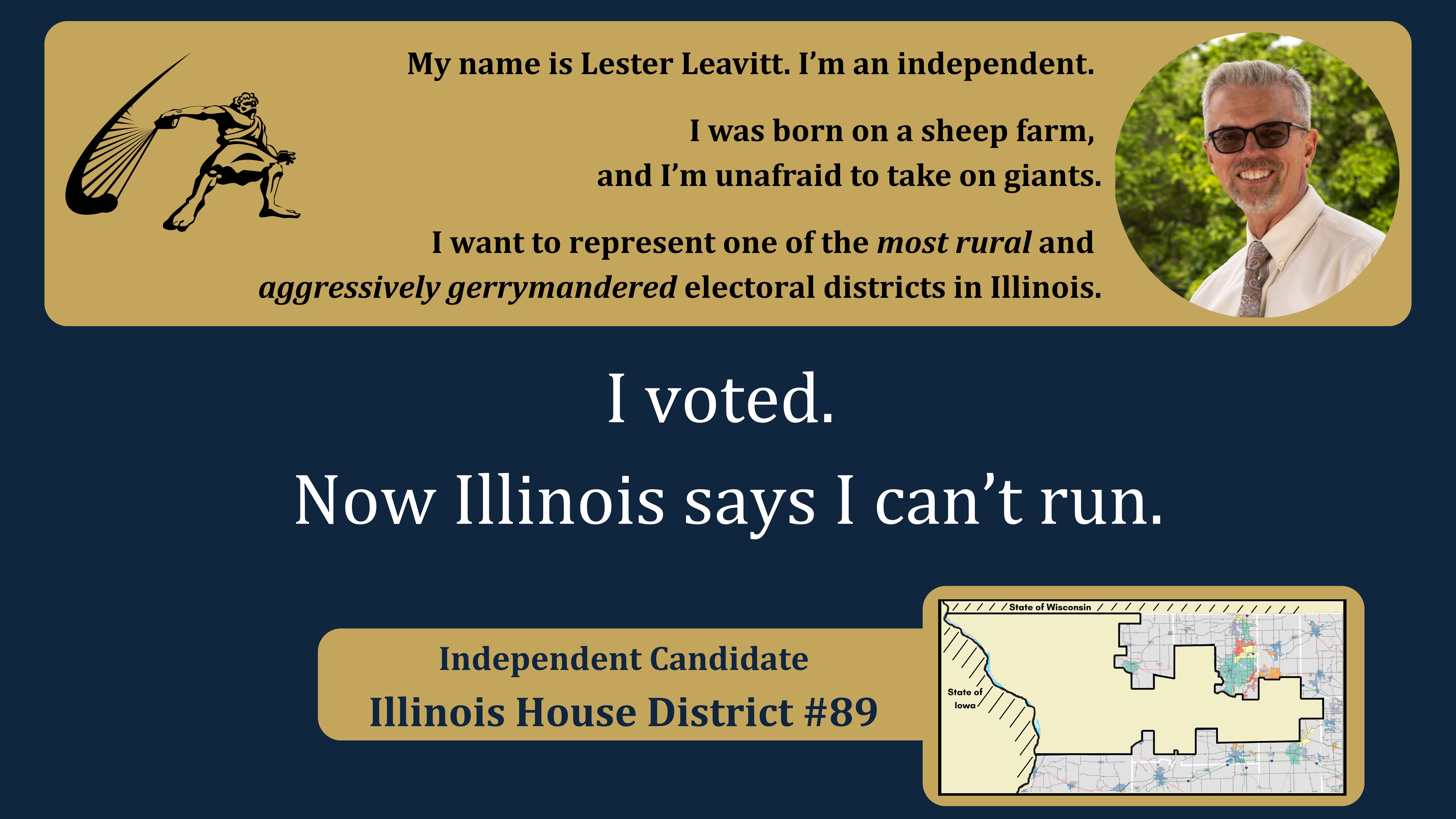
Leavitt v. Illinois State Board of Elections

I voted.
Now Illinois says I can’t run.

One vote in a primary. One line of Illinois law. One more door closed on a district that hasn’t had a real race in six years.

Lester Leavitt, independent candidate for Illinois House District 89. Born on a sheep farm, unafraid to take on giants.

Filed April 29, 2026 · Sangamon County Circuit Court

In March 2026 I voted in the Illinois primary. My precinct had no contested Democratic races at the local or regional level — only statewide primaries for governor and U.S. Senate — so I cast a Republican ballot, the only one where my vote could meaningfully count. A month later I discovered that a single line of Illinois law uses that vote to disqualify me from running as an independent candidate for State Representative this November.

I filed suit to challenge it. The ballot-filing deadline is May 26, 2026. Time is of the essence — which is why I am proceeding pro se. I cannot wait for representation if my name is to make it onto the November ballot.

How every door closed before this one

The system worked exactly as designed.

Illinois House District 89 covers seven rural counties along the Wisconsin and Iowa borders. The current incumbent has run unopposed three elections in a row. In November 2024, 10,342 voters — 17.5% of everyone who showed up — reached the line for State Representative, saw one name, and refused to ratify it. In some precincts the undervote exceeded 32%.

That is not apathy. That is a measured, precinct-level demand for choice that has been denied for six years running.

I tried every pathway the law provides. The Democratic Party infrastructure in the district has collapsed — 94 of 120 precincts have no committeeperson at all. The slating pathway that parties historically used to fill empty ballot lines was closed for the 2026 cycle by Public Act 103-0586. The independent petition route requires 2,957 signatures gathered across 95 miles of a district deliberately drawn to be ungatherable. And now Section 7-43 — a law nobody explained, no sign warned me about, no ballot language disclosed — has turned my vote into a forfeiture of my right to run.

I had read the Illinois Candidates Guide before asking nearly a hundred people to run in the primary. Nowhere in those sections — about primary candidacy, write-in rules, or spoiler provisions — did it warn anyone to not vote in a primary if they intended to run as an independent in the general election. No sign at the polling place. No instruction from a poll worker. No language on the ballot. I exercised my right to vote and unknowingly forfeited my right to seek office.

What the complaint argues

Three counts. One architecture.

The complaint raises three constitutional questions, each independently sufficient to enjoin the statute.

Count I · First Amendment

A statute that punishes voters for voting

Section 7-43 imposes a severe burden — total forfeiture of the right to appear on the ballot — triggered by the act of voting in a primary. The state’s interest in preventing spoiler candidacies cannot survive scrutiny in a district where only one party fields candidates.

Count II · Due Process

Forfeiture of a right, without notice of the rule

No signage, no poll worker instruction, no ballot language, no State Board of Elections guidance informs voters that casting a party ballot forfeits their right to run as an independent. The State may not condition the exercise of one constitutional right on the silent forfeiture of another.

Count III · Equal Protection

The rural packed district is a distinct constitutional injury

The cracked city still has a functioning democracy. It still has a mayor, a city council, contested elections, active party organizations. The four rural regions around it have none of that — by design. The mapmaker who cracked the city created five victims, not one. Section 7-43 is the final lock on a door that has already been welded shut.

Read the full case →

Support

What Spotfund covers.

I am representing myself because no attorney has yet agreed to take the case. The fund covers the cost of making the case at all:

Any funds raised beyond the immediate legal costs go toward signature-gathering operations if the injunction is granted and I’m restored to the filing calendar. Nothing raised here becomes salary.

Donate on Spotfund → Scan to donate on Spotfund
Who I am

I didn’t expect to be the plaintiff.

I live in Galena, Illinois, and I remain actively engaged in numerous community organizations. My academic background includes an MPA (Masters in Public Administration) and graduate studies toward a Ph.D. focused on how institutions sustain governing narratives — including religious ones — and on the structural barriers that are unique to street-level bureaucracies, especially in rural jurisdictions.

I’ve published eight books through Driftless Rivers Coalition, the research corporation I incorporated in 2025. My nonfiction documents the hierarchy. My speculative fiction imagines what happens when someone challenges it.

This is the fight my research prepared me for. I didn’t expect to be the plaintiff in it.

Three ways forward

Where to go from here.

Support the lawsuit

Filing fees, service of process, court reporter, and if funds permit, counsel. Every dollar closes the gap between a pro se plaintiff and a fair shot at the bench.

Donate on Spotfund →

Read the case

Full case summary, the three counts expanded, the rural packed district theory, the timeline, and the filings themselves. Written for press, attorneys, and anyone who wants the whole picture.

Leavitt v. ISBE →

See the campaign

The research behind the run, the church network, the books, and the original 300-volunteer signature plan — currently suspended pending the court’s ruling.

VoteLester campaign →